
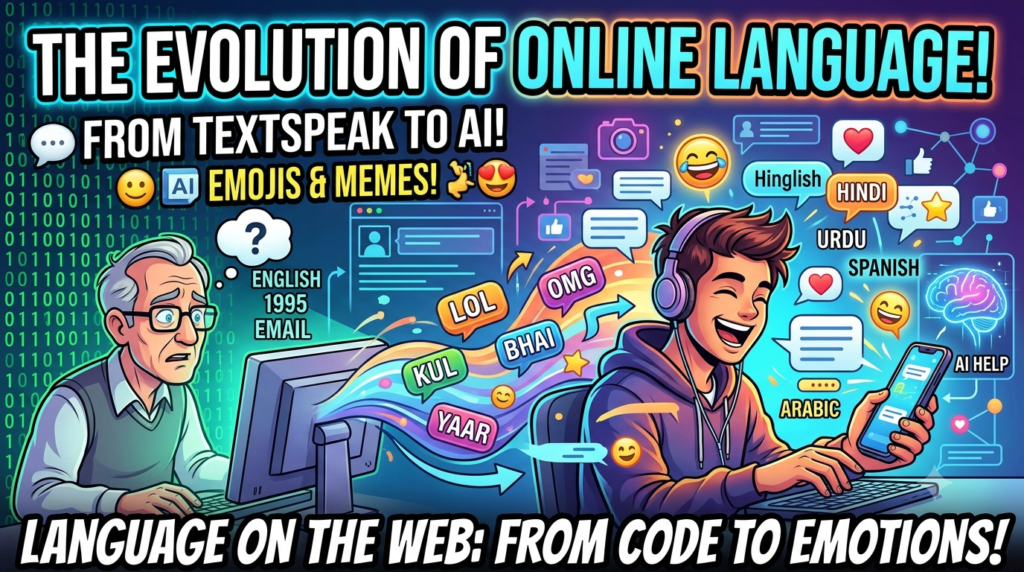
Language is a living, breathing organism. It adapts, mutates, and expands based on the environment of its speakers. For thousands of years, linguistic evolution moved at a glacial pace, dictated by geographical barriers, trade routes, and physical migrations. However, the advent of the internet and the World Wide Web shattered these traditional boundaries, introducing a catalyst for linguistic change unprecedented in human history.
Today, the web is not just a tool for transmitting information; it is a global kitchen where languages blend, clash, reinvent themselves, and sometimes fight for survival. From the early text-only bulletin boards of the 1980s to the algorithmic, video-driven social media platforms of the 2020s, the digital frontier has fundamentally altered how we write, speak, and perceive language. This article explores the multifaceted dimensions of language on the web, analyzing the hegemony of global languages, the rise of digital dialects, the visual transformation of text, and the future of human communication in an AI-driven online world.
1. The Linguistic Landscape: The Hegemony of English and the Rise of Multilingualism
The Early Internet and English Dominance
In the infancy of the World Wide Web, the internet spoke one language: English. Developed largely in the United States and powered by hardware and software architectures designed around the Latin alphabet, early digital infrastructure inherently favored English. In the mid-1990s, English accounted for over 80% of all online content.
This digital hegemony created a barrier to entry for non-English speakers. If you wanted to navigate the web, research academic papers, or participate in global forums, proficiency in English was not a luxury—it was a prerequisite.
Early Web (1990s):   [English ~80%] -> [All Other Languages Combined ~20%]
Modern Web (2020s):  [English ~50%] -> [Multilingual Expansion (Spanish, Chinese, Arabic, etc.) ~50%]
The Transition to a Multilingual Web
As internet penetration expanded globally—moving rapidly into Asia, Latin America, Africa, and the Middle East—the linguistic balance of power began to shift. The introduction of Internationalized Domain Names (IDNs) and the universal adoption of Unicode allowed scripts like Arabic, Cyrillic, Devanagari, and Chinese Hanzi to exist natively on the web.
According to recent data, while English remains the most widely used language on the web, its share of content has dropped to roughly 50-55%. Languages such as Spanish, Chinese, Russian, Arabic, and Portuguese are experiencing exponential growth online. The web is no longer a monolithic English club; it is a bustling, polyglot global marketplace.
2. The Birth of Netlingo: Slang, Abbreviations, and Digital Dialects
One of the most fascinating phenomena of language on the web is the creation of entirely new dialects, often referred to as “Netlingo,” “Internet Slang,” or “Textspeak.”
The Constraint-Driven Language
In the early days of mobile texting and internet relay chat (IRC), character limits and slow typing speeds forced users to innovate. The 160-character limit of SMS and the real-time demands of instant messaging gave birth to radical abbreviations:
- LOL (Laugh Out Loud)
- BRB (Be Right Back)
- OMG (Oh My God)
- ASL (Age/Sex/Location)
What began as a functional necessity to save space and time quickly evolved into a cultural identity. These abbreviations became symbols of digital fluency.
The Modern Meme Economy and Gen Z Slang
Fast forward to the modern web dominated by TikTok, Reddit, and Instagram, and internet slang has evolved far beyond simple abbreviations. It is now deeply tied to internet culture and meme formats. Words migrate from niche online subcultures to global mainstream vocabulary within weeks.
Terms like “No cap” (no lie), “Rizz” (charisma), “Bet” (agreement), and “Ghosting” (suddenly cutting off communication) originate online, cross international borders via algorithms, and seamlessly enter the spoken language of youth worldwide. The web acts as an accelerator, compressing linguistic evolution that used to take decades into a matter of months.
3. Romanization and Digraphia: The Case of “Hinglish” and Roman Urdu
For many communities whose native languages use non-Latin scripts, the web created a unique challenge. Typing in complex scripts like Nastaliq (for Urdu) or Devanagari (for Hindi) was historically difficult on standard QWERTY keyboards. The solution adopted by millions of users was Romanization—writing native languages using the Latin alphabet.
The Phenomenon of Roman Urdu and Hinglish
In South Asia, this gave rise to highly influential digital dialects like “Hinglish” and “Roman Urdu.” Users write phonetic representations of their spoken language:
- “Kya haal hai?” (How are you?)
- “Mujhe kal bohot kaam tha.” (I was very busy yesterday.)
This is an example of digraphia—the use of two or more writing systems for the same language. On the web, Romanized versions of native languages have become the default mode of casual communication for hundreds of millions of people. It bridges the gap between digital accessibility and cultural identity, allowing users to express themselves authentically without needing specialized keyboard layouts.
4. Visual Linguistics: Emojis, Memes, and Paralanguage
Text alone lacks the nuance of face-to-face communication. When speaking in person, we rely on tone of voice, facial expressions, and body language to convey meaning. Without these cues, written text on the web is vulnerable to misinterpretation. To fix this, the internet developed its own paralanguage—visual cues that add emotional context to text.
The Evolution of Emoticons to Emojis
The journey began in 1982 when Scott Fahlman, a computer scientist, suggested using :-) and :-( to distinguish jokes from serious statements on a bulletin board. These text-based emoticons eventually evolved into the standardized Emoji system we use today.
Emojis are not just decorative; they are grammatical tools. They function as digital punctuation marks that dictate the emotional tone of a sentence:
- “Sure 😃” (Enthusiastic agreement)
- “Sure 😐” (Reluctant or annoyed agreement)
- “Sure 💀” (Sarcastic or irony-laden response)
Memes as Cognitive Shortcuts
Memes have evolved into a sophisticated form of visual shorthand. A single meme template can convey complex cultural commentary, emotional states, or philosophical ideas instantly. Instead of writing a paragraph explaining an awkward situation, a user can simply post a specific reaction image. Memes act as a global, visual language that transcends traditional linguistic barriers, understandable by anyone immersed in web culture.
5. Code-Switching and the De-localization of Identity
On the web, geography matters less than community. A teenager in Tokyo, a designer in Milan, and a developer in Lahore can inhabit the same digital space (like a Discord server or a Subreddit) and develop a shared way of speaking.
Digital Code-Switching
Code-switching is the practice of alternating between two or more languages or varieties of language in conversation. On the web, this happens fluidly and constantly. A user might write a professional LinkedIn post in formal English, switch to a mix of English and their native language on Facebook, and use heavy internet slang and emojis on Twitter/X.
| Platform | Tone/Style | Example |
| Professional, grammatically pristine | “I am thrilled to announce that I have successfully completed…” | |
| Hybrid, casual, localized | “Yaar, check this out. Bohot urgent hai, look at it ASAP!” | |
| TikTok/X | Hyper-casual, slang-heavy, ironic | “This video is living in my mind rent-free fr fr 💀” |
This constant shifting shows how the web has made our linguistic identities multi-layered. We are no longer confined to the dialect of our hometown; we adapt our language to match the digital micro-culture we are currently engaging with.
6. The Algorithmic Influence: How Search Engines and Social Media Shape Our Words
We like to think that we choose the words we write online, but the reality is that software algorithms wield massive influence over our digital vocabulary.
Search Engine Optimization (SEO) and Content Homogenization
The economics of the web rely heavily on search engines like Google. To get discovered, writers, journalists, and businesses must practice Search Engine Optimization (SEO). This means structuring articles, headlines, and descriptions around specific keywords that people frequently search for.
While SEO makes information findable, it also leads to linguistic homogenization. Writers often abandon unique, creative, or poetic phrasings in favor of predictable, algorithm-friendly terms. If the algorithm prefers the phrase “Best budget smartphone” over “Affordable mobile gems,” every tech blog will eventually use the exact same vocabulary.
Algorithmic Censorship and “Algospeak”
On social media platforms like TikTok, YouTube, and Instagram, content moderation systems scan text and audio for banned or sensitive words. To avoid having their content suppressed, demonetized, or deleted (shadowbanned), creators have developed a protective dialect known as Algospeak.
Algospeak uses intentional misspellings, substitutions, or metaphors to bypass automated moderation:
- “Unhalive” instead of “kill” or “suicide”
- “Seggs” instead of “sex”
- “Le$bian” or using the rainbow emoji to avoid algorithmic bias against LGBTQ+ content
This is a stark example of human language mutating specifically to adapt to the rules of artificial intelligence.
7. The Impact of the Web on Traditional Literacy: Crisis or Transformation?
The radical shifts in how we write online have sparked a fierce debate among educators, linguists, and purists. Is the internet ruining language, or is it enriching it?
The Pessimistic View: The Decay of Grammar
Critics argue that the brevity and casualness of web communication are eroding formal literacy skills. They point to the breakdown of proper punctuation, the proliferation of spelling errors, and the inability of younger generations to write long-form, formal essays without slipping into textspeak. The reliance on auto-correct and predictive text is seen as a crutch that weakens individual vocabulary retention and spelling proficiency.
The Optimistic View: Enhanced Linguistic Agility
Conversely, many modern linguists, such as Gretchen McCulloch (author of Because Internet), argue that the web has made us more literate, not less. Never before in human history have people written as much as they do today. Through texts, tweets, blogs, and comments, humanity is constantly engaged in written communication.
Furthermore, internet users develop high levels of rhetorical flexibility. They learn to navigate complex social spaces, understanding instinctively that the way you write to a boss on Slack should be fundamentally different from how you write to a friend on Snapchat. This agility is a sign of linguistic intelligence, not decay.
8. Artificial Intelligence and the Future of Web Linguistics
As we look toward the future, the relationship between language and the web is entering its most disruptive phase yet, driven by Generative Artificial Intelligence (AI) and Large Language Models (LLMs).
[Human Thought]
       │
       ▼
[AI Writing Assistant (Polishing/Translating)]
       │
       ▼
[The Digital Web (Publication)]
       │
       ▼
[AI Reader/Summarizer (Processing)]
       │
       ▼
[End User Consumption]
The Influx of AI-Generated Content
With tools like ChatGPT, Claude, and automated copywriting software, a massive and growing percentage of the text published on the web is now generated or assisted by AI. This has profound implications for language:
- Hyper-Standardization: AI models are trained on historical data, meaning they tend to generate safe, grammatically flawless, but highly standardized prose. This can dilute local idioms, quirky writing styles, and human eccentricities.
- The Feedback Loop: As AI models crawl the web for data to train future generations of AI, they will increasingly train on text that was written by AI in the first place. This loop risks creating a flattened, homogenized digital language ecosystem.
Instantaneous Universal Translation
On a brighter note, AI-driven translation technologies are dismantling the final language barriers of the web. Real-time, context-aware translation tools allow a user in Brazil to read a localized, natural-sounding version of a blog post written by a creator in South Korea instantly.
This technology is moving beyond literal word-for-word translation to cultural translation, preserving idioms, humor, and emotional intent across languages. The web is moving toward a future where your native language no longer limits the content you can consume or the communities you can join.
Conclusion: The Infinite Playground of Human Expression
The internet did not destroy human language; it liberated it from the confines of the printed page. The World Wide Web has transformed writing from a static, one-way medium into an interactive, dynamic, and collaborative art form.
Through the combination of text, images, emojis, and memes, the web has allowed humanity to develop a richer, more expressive paralanguage that bridges the emotional gaps of distance. It has allowed minor languages to find a digital home, gave rise to innovative hybrid dialects like Hinglish, and turned everyday internet users into active creators of vocabulary.
As we move deeper into an era dominated by algorithms and artificial intelligence, language on the web will undoubtedly continue to shift. The tools we use to navigate the digital world will shape the words we choose, but the core driver of language will always remain intensely human: the unstoppable desire to connect, to be understood, and to express the intricate nuances of our shared existence.
Summary Matrix: The Evolution of Web Communication
| Era | Primary Medium | Key Linguistic Characteristics | Dominant Cultural Driver |
| Web 1.0 (1990s) | Static Web Pages, Email, Forums | Monolingual (English), Formal Text, Early Emoticons :-) | Academic & Technical Infrastructure |
| Web 2.0 (2000s-2010s) | Social Media, Blogs, Smartphones | Textspeak (LOL, BRB), Multilingualism, Emojis, Early Memes | User-Generated Content & Mobility |
| Modern Web (2020s) | Short-form Video, Algorithmic Feeds | Algospeak, Gen Z Slang, Rich Visual Shorthand, Code-Switching | Algorithmic Distribution & Meme Economy |
| The AI Web (Future) | LLMs, Real-Time Translation | AI-Assisted Prose, Automated Translation, Hyper-Standardization | Generative Artificial Intelligence |