
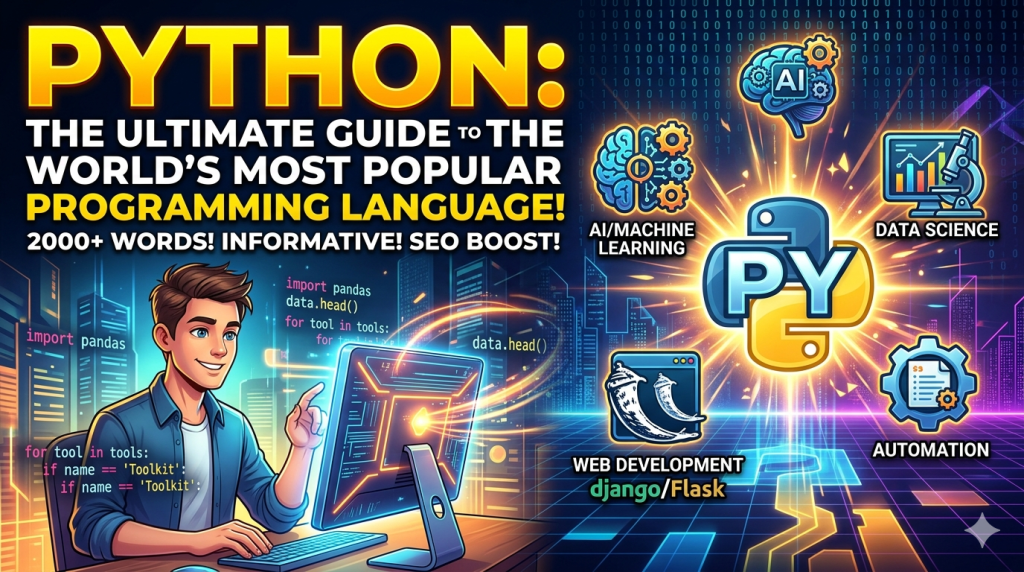
In the rapidly evolving landscape of technology, if there is one language that has democratized coding for everyone—from data scientists to financial analysts and web developers—it is Python. Known for its simplicity, power, and versatility, Python has climbed the ranks to become the most sought-after language in 2026.
Whether you are looking to automate boring tasks, build a complex web application, or dive into the world of Artificial Intelligence, Python is the gateway. In this exhaustive guide, we will explore why Python is the “Swiss Army Knife” of programming and how it is shaping the future.
1. What is Python? (The Human-Centric Language)
Python is a high-level, interpreted, and general-purpose programming language. Created by Guido van Rossum and first released in 1991, its design philosophy emphasizes one thing above all else: Readability.
Unlike languages like C++ or Java, which require complex syntax and many lines of code to perform simple tasks, Python feels like writing in English. This low barrier to entry is exactly why it is the first choice for beginners worldwide.
2. Why is Python Dominating in 2026?
Several factors contribute to Python’s unmatched popularity:
A. Simplicity and Readability
Python uses a clean syntax that relies on indentation (whitespace) rather than curly braces or semicolons. This makes the code easier to maintain and debug.
B. Massive Library Support
Python’s greatest strength is its “batteries-included” philosophy. With over 300,000 packages in the Python Package Index (PyPI), you don’t have to reinvent the wheel. Whether you need to scrape a website or analyze a spreadsheet, there is already a library for it.
C. Portability
Python code can run on Windows, macOS, Linux, and even microchips without needing modification.
3. The Core Applications of Python
Python is not just for web development; its reach is incredibly broad.
I. Data Science and Analytics
Python is the undisputed king of data. Tools like Pandas, NumPy, and Matplotlib allow users to clean, manipulate, and visualize massive datasets with just a few lines of code.
II. Artificial Intelligence and Machine Learning
Every major AI breakthrough—from ChatGPT to self-driving cars—relies heavily on Python. Libraries like TensorFlow, PyTorch, and Scikit-learn provide the framework for building intelligent systems.
III. Web Development
While JavaScript handles the front-end, Python is a powerhouse for the back-end (server-side). Frameworks like Django and Flask allow developers to build secure, scalable websites quickly.
IV. Automation and Scripting
This is where Python shines for daily users. You can write a “script” to:
- Automatically rename thousands of files.
- Send bulk emails.
- Track price drops on e-commerce sites.
- Convert PDF files to Excel.
4. Python for Tool-Based Websites
If you are running a utility-based website, Python is often the “engine” under the hood.
For example, if your website offers a “PDF to Image Converter,” Python handles the heavy lifting on the server using libraries like PyMuPDF. If you have an “SEO Keyword Analyzer,” Python’s Requests and BeautifulSoup libraries fetch and process that data in seconds.
5. Learning the Basics: A Quick Start
To understand Python, you only need to grasp a few concepts:
- Variables:
name = "Toolkit"(No need to declare data types). - Lists:
tools = ["Calculator", "Converter", "Editor"]. - Loops:
for x in tools: print(x)(Automating repetitive tasks). - Functions: Defining a block of code that performs a specific calculation.
6. Python vs. Other Languages
How does Python stack up against its competitors?
| Feature | Python | Java | C++ |
| Learning Curve | Very Easy | Moderate | Hard |
| Speed | Moderate (Interpreted) | Fast (Compiled) | Very Fast |
| Applications | AI, Data, Web | Enterprise, Android | Systems, Gaming |
| Syntax | Minimalist | Verbose | Complex |
7. Python’s Ecosystem: Essential Libraries to Know
If you are building something with Python, these are the tools you will likely use:
- Requests: For making HTTP calls to APIs.
- Selenium: For browser automation and testing.
- OpenCV: For image processing and computer vision.
- FastAPI: For building high-performance APIs for your web tools.
8. SEO Benefits of Python Content
Writing about Python is excellent for SEO. Because Python is used by students, researchers, and professional developers, the search volume for Python-related queries is consistently high. By providing informative guides, you can capture a wide demographic of “tech-savvy” users who are likely to use your digital tools.
9. The Future: Python in the Age of Quantum and Edge Computing
As we move further into 2026, Python is adapting. Projects like PyScript now allow Python to run directly in the web browser (similar to JavaScript), and Qiskit is making Python the standard for Quantum Computing. It is a language that grows with the times.
10. Conclusion
Python is more than just a programming language; it is a community and a vast resource of human knowledge. Its ability to simplify the complex makes it an essential topic for any tech-focused platform. For creators and developers, Python isn’t just a skill—it’s a superpower.