
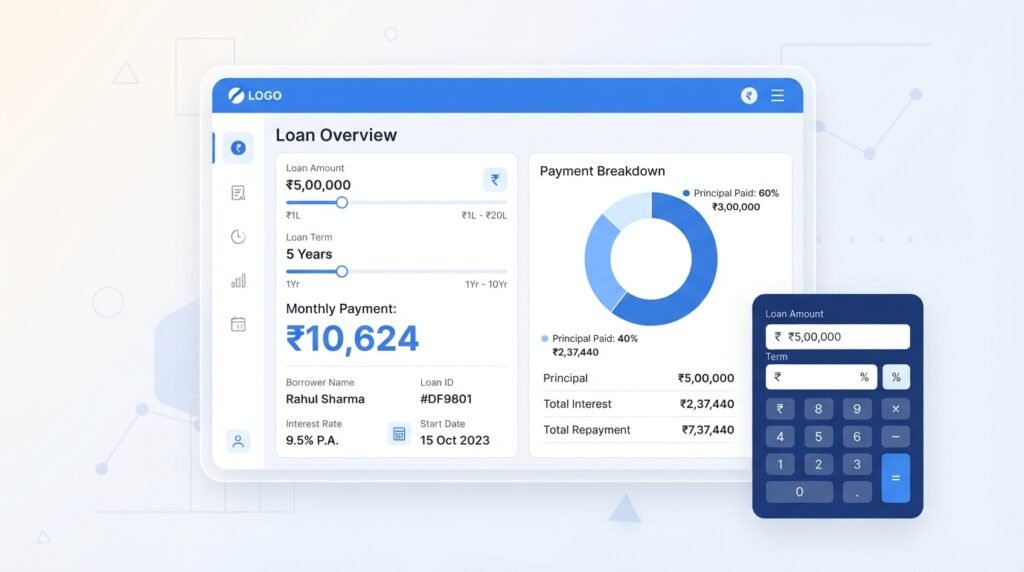
Planning to take a loan for a home, car, or personal need? Before signing anything, you need to know exactly how much you will pay every month. This guide explains what EMI is, how it is calculated, and how to use a free EMI calculator to plan your finances smartly.
1. What Is EMI?
EMI stands for Equated Monthly Installment. It is the fixed amount you pay to your bank or lender every month until your loan is fully repaid. Each EMI payment covers two components:
- Principal — the portion of your original loan amount being repaid
- Interest — the cost charged by the lender for giving you the loan
In the early months of a loan, a larger portion of your EMI goes toward interest. As time passes, more of each payment goes toward reducing the principal. This is called an amortizing loan structure.
💡 Good to Know: Your EMI amount stays the same every month throughout the loan tenure — but the split between principal and interest changes with each payment.
2. How Is EMI Calculated?
The standard EMI formula used by all banks is:
EMI = P × R × (1+R)^N ÷ [(1+R)^N – 1]
Where:
- P = Principal loan amount
- R = Monthly interest rate (Annual rate ÷ 12 ÷ 100)
- N = Total number of monthly installments (loan tenure in months)
Example:
Loan amount: Rs. 1,000,000
Annual interest rate: 18%
Loan tenure: 3 years (36 months)
Monthly rate R = 18 ÷ 12 ÷ 100 = 0.015
EMI = 1,000,000 × 0.015 × (1.015)^36 ÷ [(1.015)^36 – 1]
EMI = Rs. 36,152 per month
You do not need to do this math yourself. ToolkitsPro’s free EMI Calculator handles it instantly — just enter your loan amount, interest rate, and tenure.
3. How to Calculate Your EMI Online — Step by Step
Step 1: Open the EMI Calculator
Go to toolkitspro.online/emi-calculator/. No account or download needed — works on any device instantly.
Step 2: Enter Your Loan Amount
Type in the total amount you want to borrow. For example, Rs. 500,000 for a personal loan or Rs. 5,000,000 for a home loan.
Step 3: Enter the Interest Rate
Enter the annual interest rate your bank has quoted. If you are not sure, check your loan offer letter or ask your bank. Typical rates in Pakistan range from 15% to 25% depending on the loan type and lender.
Step 4: Enter the Loan Tenure
Enter how many months or years you want to repay the loan over. Longer tenure means lower monthly EMI but higher total interest paid.
Step 5: Get Your Result
Click Calculate. The tool instantly shows your monthly EMI, total amount payable, and total interest cost over the full loan period.
✅ Pro Tip: Try different tenures to find the best balance. A 2-year loan has higher EMI but you pay far less interest overall. A 5-year loan has lower EMI but costs significantly more in total interest.
4. Types of Loans and Their Typical EMIs
| Loan Type | Typical Amount | Typical Rate (Pakistan) | Common Tenure |
|---|---|---|---|
| Personal Loan | Rs. 50,000 – 2,000,000 | 18% – 28% | 1 – 5 years |
| Car Loan | Rs. 500,000 – 5,000,000 | 15% – 22% | 3 – 7 years |
| Home Loan | Rs. 1,000,000 – 50,000,000 | 15% – 20% | 5 – 20 years |
| Business Loan | Rs. 200,000 – 10,000,000 | 16% – 24% | 1 – 7 years |
| Education Loan | Rs. 100,000 – 2,000,000 | 12% – 18% | 2 – 10 years |
5. Understanding Your EMI Breakdown
When you take a loan, your total repayment includes much more than just the borrowed amount. Here is what you are actually paying:
Principal Amount
This is the money you actually borrowed. Every EMI payment slowly reduces this balance until it reaches zero at the end of your loan tenure.
Interest Cost
This is what the bank charges for lending you money. The longer your tenure and the higher the interest rate, the more interest you pay in total. For a Rs. 1,000,000 loan at 20% for 5 years, you end up paying approximately Rs. 650,000 in interest alone — on top of the original million.
Total Cost of Loan
Always look at the total amount payable, not just the monthly EMI. A low monthly payment can be misleading if the loan tenure is very long and total interest is very high.
6. Tips for Managing Your EMI Smartly
Borrow Only What You Need
The smaller your principal, the lower your EMI and total interest. Avoid the temptation to borrow more than required just because the bank approves a higher amount.
Choose the Shortest Tenure You Can Afford
A shorter tenure means higher monthly payments but dramatically lower total interest cost. Calculate both options using the EMI calculator before deciding.
Make Prepayments When Possible
If you have extra money — a bonus, salary increase, or savings — paying a lump sum toward your principal reduces your outstanding balance and future interest significantly. Always check if your bank charges a prepayment penalty before doing this.
Compare Multiple Banks
Even a 1-2% difference in interest rate makes a significant difference over a long loan tenure. Always compare offers from at least 3-4 banks before finalizing.
Keep EMI Below 40% of Monthly Income
A general rule followed by most financial advisors: your total monthly EMI payments (across all loans) should not exceed 40% of your monthly take-home salary. Going above this creates financial stress and increases default risk.
7. EMI vs. Bullet Payment vs. Reducing Balance
| Payment Type | How It Works | Best For |
|---|---|---|
| EMI (Fixed) | Equal monthly payments throughout tenure | Salaried individuals, predictable budgets |
| Bullet Payment | Pay full amount at end of tenure | Short-term business needs |
| Reducing Balance | Interest calculated on remaining principal | Saves more interest over time |
Most bank loans in Pakistan use the reducing balance method for interest calculation, which is better for borrowers than flat rate interest.
8. Frequently Asked Questions
Is the EMI Calculator free?
Yes, completely free with no sign-up, no account, and no limits. Calculate as many loan scenarios as you need.
Can I calculate EMI for different loan types?
Yes. The same EMI formula applies to home loans, car loans, personal loans, and business loans. Simply enter the relevant amount, rate, and tenure for each.
What is a good EMI to income ratio?
Most financial advisors recommend keeping your total monthly EMI below 40% of your monthly net income. This ensures you have enough left for living expenses and savings.
Does the calculator account for processing fees?
No. Banks often charge processing fees, insurance, and other charges on top of the loan. These are separate from the EMI — always ask your bank for the total cost of borrowing.
What happens if I miss an EMI payment?
Missing an EMI payment results in late payment charges and negatively affects your credit score (CIBIL/eCIB in Pakistan). Consistent missed payments can lead to loan default and legal action by the lender.
Can I reduce my EMI after taking a loan?
Yes, through loan restructuring or refinancing. You can ask your bank to extend the tenure (which lowers monthly EMI) or transfer the loan to another bank offering a lower interest rate.
Is EMI the same as SIP?
No. EMI is a loan repayment installment — money going out to repay debt. SIP (Systematic Investment Plan) is a regular investment into a mutual fund — money being saved and grown. They are completely different financial concepts.
Related Tools You Might Need
- SIP Calculator — Calculate how much your monthly investments will grow over time.
- Mortgage Calculator — Plan your home loan repayments in detail.
- Salary Calculator — Calculate your take-home pay to plan how much EMI you can afford.
- Age Calculator — Useful for planning loan tenure against your retirement age.
Try It Now: Calculate Your EMI Free →