
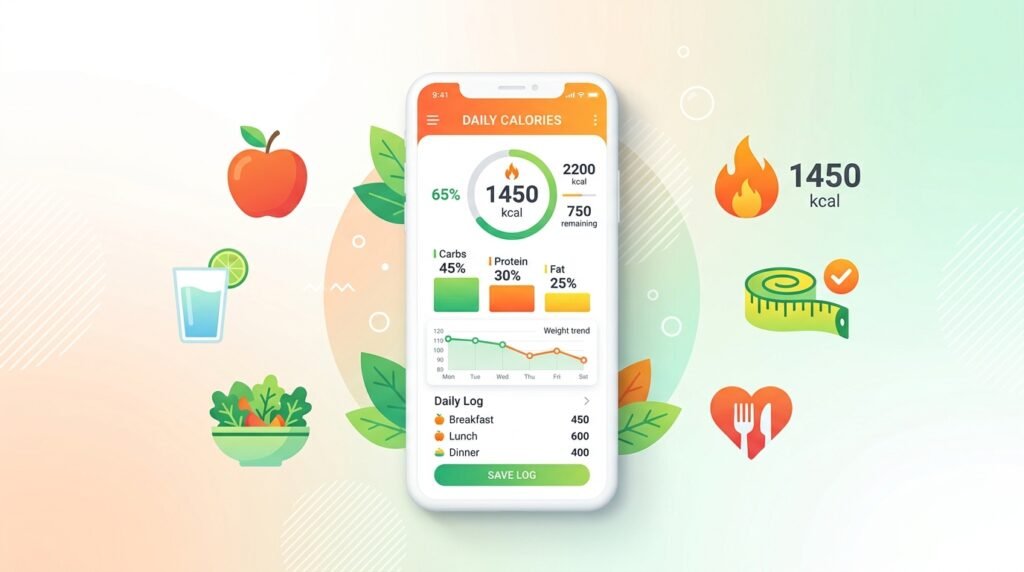
Whether your goal is to lose weight, build muscle, or simply maintain your current shape, everything starts with one number: how many calories your body needs every day. Guessing this number is one of the biggest reasons diets fail — eat too little and your metabolism slows down, eat too much and the scale won’t move in the direction you want.
The good news? You don’t need a nutritionist or complicated math to find this out. Our free Calorie Calculator does it for you in seconds, giving you your BMR, TDEE, and a personalized daily calorie target — along with a macro breakdown.
In this guide, we’ll explain what these numbers actually mean, how they’re calculated, and exactly how to use them to reach your fitness goals.
What Is a Calorie Calculator?
A calorie calculator is a tool that estimates the number of calories your body burns in a day based on factors like your age, gender, height, weight, and activity level. This number tells you roughly how much you can eat while maintaining your current weight — and from there, you can adjust up or down depending on whether you want to gain, lose, or maintain weight.
Understanding BMR and TDEE
Two terms you’ll see on every calorie calculator are BMR and TDEE. Understanding the difference makes the results much easier to use.
BMR (Basal Metabolic Rate)
Your BMR is the number of calories your body burns just to stay alive — breathing, circulating blood, repairing cells, and keeping your organs running — if you stayed in bed all day. It does not include any movement or exercise.
TDEE (Total Daily Energy Expenditure)
Your TDEE takes your BMR and adds the calories you burn through daily activities, exercise, and digestion. This is the real number that matters for weight management, because it reflects your actual lifestyle, not just your body at rest.
TDEE = BMR × Activity Multiplier
Activity multipliers typically range from:
- Sedentary (little or no exercise): BMR × 1.2
- Lightly active (light exercise 1-3 days/week): BMR × 1.375
- Moderately active (moderate exercise 3-5 days/week): BMR × 1.55
- Very active (hard exercise 6-7 days/week): BMR × 1.725
- Extra active (physical job + intense training): BMR × 1.9
How Calorie Calculators Work (The Formula)
Most modern calorie calculators, including ours, use the Mifflin-St Jeor Equation, which is widely considered one of the most accurate formulas for estimating BMR:
- For men: BMR = (10 × weight in kg) + (6.25 × height in cm) − (5 × age) + 5
- For women: BMR = (10 × weight in kg) + (6.25 × height in cm) − (5 × age) − 161
Once your BMR is calculated, it’s multiplied by your activity level to get your TDEE — and that TDEE becomes the baseline for your calorie goals.
How to Use Our Free Calorie Calculator
Using the ToolkitsPro Calorie Calculator takes less than a minute:
- Enter your basic details — age, gender, height, and current weight.
- Select your activity level from the dropdown (sedentary to extra active).
- Choose your goal — lose weight, maintain weight, or gain weight/muscle.
- Click Calculate to instantly see your BMR, TDEE, and recommended daily calorie intake.
- Review your macro breakdown — protein, carbs, and fats — so you know not just how much to eat, but what to eat.
No sign-up, no app download, and no data is stored — just instant, accurate results every time you need them.
How Many Calories Should You Eat to Lose Weight?
A safe and sustainable rate of weight loss is about 0.5–1 kg (1–2 lbs) per week. To achieve this, most people create a calorie deficit of 500-750 calories per day below their TDEE.
For example, if your TDEE is 2,200 calories:
- Mild weight loss: 1,900–2,000 calories/day
- Moderate weight loss: 1,700–1,800 calories/day
Going much lower than this can lead to muscle loss, fatigue, and a slower metabolism over time, so it’s best to avoid extreme deficits.
How Many Calories Should You Eat to Gain Weight or Build Muscle?
To build muscle, you generally need a calorie surplus of 250-500 calories per day above your TDEE, combined with adequate protein intake (roughly 1.6-2.2g of protein per kg of body weight) and resistance training.
Why Tracking Calories Matters
Many people underestimate how much they eat by 20-30% simply because they don’t measure portions or count hidden calories from drinks, sauces, and snacks. Knowing your target number — and tracking your intake against it — is one of the most effective tools for reaching your health goals, whether that’s fat loss, muscle gain, or simply maintaining a healthy weight long-term.
Frequently Asked Questions
Is this calorie calculator accurate? It uses the Mifflin-St Jeor equation, which is one of the most reliable formulas for estimating calorie needs for the general population. However, individual metabolism can vary, so use the result as a strong starting point and adjust based on your real-world progress over 2-3 weeks.
How often should I recalculate my calorie needs? Recalculate whenever your weight changes by more than 2-3 kg, your activity level changes significantly, or every 4-6 weeks during an active diet or bulk.
Does this calculator account for muscle mass? The standard formula doesn’t directly account for body composition. If you have a very high or low muscle mass, your actual needs may differ slightly from the estimate.
Is the tool free to use? Yes, the Calorie Calculator on ToolkitsPro is completely free, requires no signup, and works on mobile and desktop.
Final Thoughts
Your daily calorie target is the foundation of any successful nutrition plan — everything else (macros, meal timing, food choices) builds on top of it. Instead of guessing, take 30 seconds to get a personalized number with our free Calorie Calculator, and use it as your starting point for a healthier, more informed approach to eating.
Looking for more free tools to support your health and productivity? Explore our full toolkit library for calculators, converters, and utilities — all free, fast, and secure.Share