
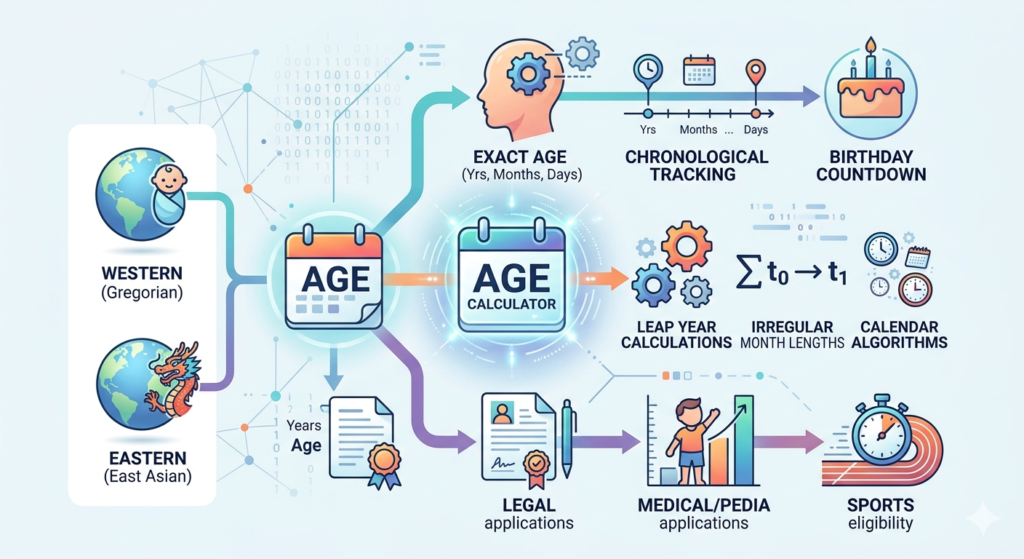
Have you ever found yourself pausing midway through filling out an official application, trying to calculate exactly how many months or days you’ve been alive? Or perhaps you are managing a business, organizing a sporting event, or filling out critical legal documentation where an approximate guess simply will not cut it. While knowing your age in whole years is easy, breaking that lifespan down into exact months, weeks, days, hours, and even seconds requires navigating a web of shifting calendar mathematics.
This is exactly why high-utility web tools exist. Instead of wrestling with standard math, variable month lengths, and the irregular rhythm of leap years, using a precise digital utility can instantly solve your problem.
This comprehensive, deeply researched article serves as the ultimate companion guide to online age calculation. Below, we explore the deep mathematics behind time tracking, how different cultures around the globe interpret aging, the practical and legal real-world uses of exact chronological age data, and a step-by-step breakdown of how modern algorithms compute your time on Earth with absolute precision.
Why Precise Chronological Age Estimation Matters
For everyday conversations, stating your age in years is perfectly fine. If someone asks how old you are, you say “25” or “42.” However, the modern world operates on precise data streams. There are dozens of professional, legal, medical, and personal scenarios where an estimation is not just unhelpful—it can result in rejected paperwork or calculated errors.
1. Legal and Government Compliance
When applying for a passport, a driver’s license, a visa, or national identity documents, administrative systems do not just ask for your birth year; they cross-reference your exact day of birth against the current date. In many legal jurisdictions, a person does not turn a specific legal age on the morning of their birthday, but rather at the exact conclusion of the day preceding it, or at the precise minute of birth depending on regional penal codes. Immigration departments routinely use automated chronological calculators to determine if a minor dependent qualifies under specific family sponsorship visas based on their exact age down to the day on the date the application was filed.
2. Medical, Pediatric, and Veterinary Sciences
In medicine, age precision can be a matter of life and death. This is most visible in pediatrics. A baby who is 4 weeks old has completely different developmental markers, vaccination schedules, and medication dosage tolerances than a baby who is 8 weeks old, even though both are technically “one month old” in casual speech.
Medical professionals calculate dosages based on exact daily or monthly age brackets because metabolic rates scale rapidly in early human development. The same rule applies to veterinary medicine, where the life stages of domestic animals progress at accelerated rates compared to humans, making precise month-and-week calculation vital for treatments.
3. Sports Administration and Competitive Brackets
Youth sports organizations, international athletic federations, and scholastic leagues use strict age brackets to ensure fair competition. To prevent “relative age effect”—where children born early in the selection year have an unfair physical advantage over children born later in the same year—leagues set strict eligibility cut-off dates. An exact age tracking tool allows regulators, coaches, and parents to check if an athlete falls within a specific competitive range on a set target date.
4. Financial Planning, Insurance, and Retirement Eligibility
Actuarial tables used by life insurance companies rely entirely on precise age parameters to calculate risk profiles and monthly premiums. Similarly, government pension schemes, corporate retirement funds, and social security programs require workers to hit precise age targets (such as 62 years and 8 months) to unlock full or partial benefits. Calculating the exact gap between your current date and your retirement target helps in mapping out financial portfolios accurately.
The Complex Mathematics Behind the Calendar
To understand why a dedicated calculator tool is necessary, it helps to peel back the curtain on how human civilizations have organized time. Calculating the distance between two calendar points seems like it should be simple addition and subtraction, but the calendar we use today is a complex patch-work design engineered to track astronomy, not smooth arithmetic.
The Problem of the Solar Year
The core issue is that the Earth does not orbit the Sun in a perfectly round number of days. A single astronomical solar year (the time it takes for the Earth to complete one full revolution around the Sun) is approximately 365.24219 days.
Because humans prefer whole numbers for their daily schedules, we use the Gregorian calendar, which sets a standard year to 365 days. However, that leaves an extra fraction of a day (~0.2422 of a day) left over every single year. If we ignored this fraction, our calendar would drift out of alignment with the physical seasons by about 24 days every single century. Eventually, July would take place in the middle of winter in the Northern Hemisphere.
Leap Year Intercalation Rules
To fix this drift, Julius Caesar first introduced the Julian calendar, which added an extra day every four years (a leap year). While this was a massive leap forward, it overcorrected slightly by assuming a year was exactly 365.25 days long.
By 1582, the calendar had drifted by 10 days. Pope Gregory XIII introduced the Gregorian calendar to refine the system, creating the leap year rules that our modern computers and web tools still calculate today. Under this standard system, a year is a leap year if it meets the following criteria:
- The year must be evenly divisible by 4.
- If the year can be evenly divisible by 100, it is not a leap year, unless…
- The year is also evenly divisible by 400.
This means that while the year 2000 was a leap year (divisible by 400), the years 1700, 1800, and 1900 were not. When a digital age calculator counts the time between a person born in 1996 and the year 2026, its background code must actively evaluate every single year along that timeline to check if a 29th day in February needs to be added to the running total.
Shifting Month Lengths
Compounding the leap year problem is the fact that months are highly irregular. Gregorian months range from 28 days (or 29 in leap years) to 30 and 31 days. If you are born on March 31st and want to know your age on April 30th, you have lived exactly one month. But if you are born on January 31st and look at your age on February 28th, you have also lived exactly one month within the calendar context, despite living fewer physical days. Tracking these irregular shifts manually requires a heavy cognitive load; code libraries handle this instantaneously.
Step-by-Step Guide: How to Calculate Age with a Digital Tool
Using an online platform to break down your age makes a complicated math process smooth and immediate. The operational flow below explains how the frontend user experience directly translates into backend computation:
1.Enter the Date of Birth:Input Step.
The user selects their exact day, month, and year of birth using an interactive drop-down interface or a digital calendar grid picker. This establishes the fixed historical starting point ($t_0$).
2.Set the Target Comparison Date:Control Step.
By default, the tool sets the endpoint ($t_1$) to the current real-time system date. However, users can modify this field to any past or future date to determine milestone countdowns or historical age timelines.
3.Run the Chronological Algorithm:Execution Step.
When clicking the “Calculate” button, the engine runs a system check. It first subtracts the birth year from the target year, then adjusts the tally down by one if the target month and day have not yet been reached in the current cycle.
4.Analyze the Granular Breakdown:Output Step.
The user is presented with an instantaneous, scannable dashboard displaying their exact age in complete years, remaining months, and remaining days, accompanied by complete metrics in raw weeks, days, hours, and seconds.
Cultural Differences in Age Reckoning
One of the most fascinating aspects of age calculation is that “age” itself is a cultural construct. The concept of counting your age based purely on the number of birthdays you have celebrated is highly tied to Western traditions. Across the globe, alternative systems change the math entirely.
1. The East Asian Age Reckoning System (Traditional)
In traditional cultures across China, Korea, Japan, and Vietnam, a person’s age is calculated differently than in the West. Under this traditional method, a newborn child is considered one year old the moment they are born. This reflects the time spent developing inside the womb, rounding up to a whole year.
Furthermore, instead of gaining a year on their individual birthday, everyone collectively adds another year to their age on New Year’s Day (often the Lunar New Year). This means that if a baby is born on the day before the Lunar New Year, they are considered one year old at birth. The next day, when the new year rings in, they turn two years old, despite having been alive for less than 48 hours.
While modern international business and government filings in Asian nations have shifted to the Western standard, traditional age reckoning remains culturally relevant for festivals, family dynamics, and astrological readings.
2. The Hijri (Islamic) Calendar Calculation
The Islamic calendar is entirely lunar, tracking the cycles of the moon rather than the sun. A Hijri year consists of 12 lunar months, totalizing roughly 354 or 355 days per year. This makes a lunar year approximately 11 days shorter than a standard solar year.
Because of this difference, if you calculate your age using the Hijri calendar, you will actually be numerically older than you are under the Gregorian system. For instance, a person who is 32 years old in a solar framework will be roughly 33 years old in an Islamic lunar framework. Many online utility suites feature toggle options to switch systems, catering to users who need to track religious milestones or comply with regional legal standards in countries utilizing lunar frameworks.
The Metric Conversion of Human Life
To truly comprehend the depth of our existence, looking at our lives purely through the lens of “years” can obscure just how much time has passed. Breaking age down into its lowest common denominators provides an entirely new perspective on personal history.
Consider a person who has just reached their 30th birthday. Let’s examine how that looks when converted into various time increments using standard mathematical formulas:
| Time Unit | Mathematical Conversion Strategy | Total Accumulated Units (At 30 Years) |
| Years | Baseline lifespan measurement | 30 Years |
| Months | $\text{Years} \times 12$ | 360 Months |
| Weeks | $\frac{\text{Total Days}}{7}$ | ~1,565 Weeks |
| Days | $(\text{Years} \times 365) + \text{Leap Days}$ | 10,957 Days |
| Hours | $\text{Total Days} \times 24$ | 262,968 Hours |
| Minutes | $\text{Total Hours} \times 60$ | 15,778,080 Minutes |
| Seconds | $\text{Total Minutes} \times 60$ | 946,684,800 Seconds |
Seeing your life laid out as nearly one billion seconds highlights why high-precision calculators are such engaging tools. They change abstract blocks of calendar years into an active, hyper-specific ticker of human experience.
Technical Architecture of a Web-Based Calculator
For web developers, site administrators, and software engineers, building a tool that handles date intervals looks easy until you start testing edge cases. If you are constructing an age calculator using modern web technologies like JavaScript, Python, or PHP, you must account for systemic programming challenges.
The Problem of the Unix Epoch
Most computing platforms calculate time using a system known as Unix Time or Epoch Time. This system tracks the number of seconds that have elapsed since January 1, 1970, at 00:00:00 UTC.
If a user enters a birth date prior to 1970, the computer represents that date as a negative integer. For individuals born in the 1940s, 1950s, or 1960s, a basic Javascript timestamp operation can break or experience integer underflow bugs if it isn’t properly scaled using native modern date objects (like Javascript’s Date() constructor or Python’s datetime module).
Handling Client-Side Timezone Drift
A common flaw in poorly designed web utilities is timezone shifting. If a user living in Tokyo opens a webpage at 1:00 AM on June 1st, their local browser clock reads June 1st. However, the server hosting the website might be located in New York, where the clock reads 12:00 PM on May 31st.
If the calculator script relies on server-side rendering without passing timezone offsets, it can output a result that is off by an entire day. Premium digital tools prevent this by executing the script entirely client-side inside the user’s browser environment, ensuring that “Today’s Date” perfectly aligns with the user’s localized physical reality.
Frequently Asked Questions (FAQ)
What is the difference between biological age and chronological age?
Chronological age is the exact amount of time that has passed from your birth to the present moment, measured strictly by the calendar. Biological age refers to how old your cells and tissues are based on biomarkers, lifestyle, genetics, and health. While your chronological age increases predictably every year, your biological age can be slowed down or accelerated by fitness and environment.
Why do some online age calculators give different day counts for the same birth date?
If you notice discrepancies between different online utilities, it is usually because one tool is showing a raw count of total elapsed days, while another is breaking down the age into a nested framework of years, months, and days. Discrepancies can also occur if an algorithm fails to correctly count leap days, or if it uses an average month value (like 30.41 days) instead of mapping the true physical length of each specific month.
How does the calculator handle time zones for people born at midnight?
Most basic web forms only request the date of birth, not the exact minute. Therefore, calculators assume a baseline start time of 12:00 AM (midnight) on your date of birth. If you require precise minute-by-minute calculations for natal astrology or medical registries, you must use an advanced interval tracker that accepts hour/minute inputs alongside standard calendar dates.
Can I save or export the data from these calculations?
Most utility platforms operate as live sandbox engines, meaning they process inputs instantly and discard them the moment you refresh or close the browser tab. This is a deliberate security feature designed to safeguard user privacy, ensuring that personal data remains entirely within your local browser ecosystem.
Explore More Related Digital Utilities
Managing data, tracking text metrics, and handling media assets shouldn’t slow down your workflow. Our platform features an expansive collection of free, high-performance web applications built to deliver immediate results with zero server logs.
If you found our chronological interval system helpful, optimize your next digital task with our most popular utility extensions:
🛠️ Core Optimization Tools
- Word Counter Tool – Streamline your content strategy instantly. This real-time text analyzer monitors character densities, sentence limits, and structural readability markers ideal for securing search indexing approval.
- Image Compressor – Reduce heavy visual files by up to 80% without losing visual clarity. This module lets you optimize media payloads directly inside your browser cache before running live server migrations.
- Days Calculator – Need to track the exact timeline boundaries between two completely different calendar targets without counting individual year parameters? Drop your start and end values here for an instant layout.
Note on Data Security: Your digital safety is paramount. All computations processed through our online utility modules utilize localized client scripting arrays. No personal biographical inputs, birth markers, or text strings are ever stored, indexed, or shared with external database servers.