
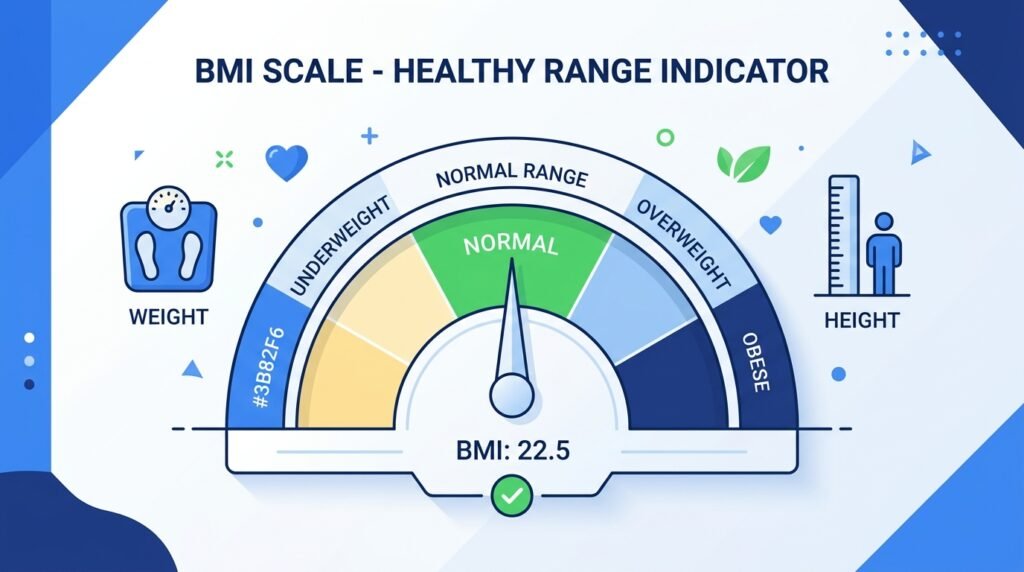
Wondering if your weight is healthy for your height? BMI is the fastest way to find out. This guide explains exactly what BMI means, how to calculate it correctly, what your result means, and how to use it to make better health decisions.
1. What Is BMI?
BMI stands for Body Mass Index. It is a simple numerical value calculated from your height and weight that gives a general indication of whether your body weight is in a healthy range for your height.
BMI was developed in the 1830s by Belgian mathematician Adolphe Quetelet and has been used by doctors, nutritionists, and health organizations worldwide ever since. The World Health Organization (WHO) uses BMI as a standard screening tool for weight-related health risks in adults.
💡 Good to Know: BMI is a screening tool, not a diagnosis. A high or low BMI does not automatically mean you have a health problem — it simply indicates that further evaluation may be useful.
2. How Is BMI Calculated?
The BMI formula is straightforward:
BMI = Weight (kg) ÷ Height (m)²
For example, if you weigh 70kg and are 1.75m tall:
BMI = 70 ÷ (1.75 × 1.75) = 70 ÷ 3.0625 = 22.9
If you use pounds and inches, the formula is:
BMI = (Weight in lbs × 703) ÷ Height (inches)²
You do not need to do this math manually. Our free BMI Calculator handles the calculation instantly — just enter your height and weight and get your result in seconds.
3. What Do BMI Numbers Mean?
Once you have your BMI number, use this standard WHO classification to understand what it means:
| BMI Range | Category | What It Means |
|---|---|---|
| Below 18.5 | Underweight | May indicate nutritional deficiency or other health issues |
| 18.5 — 24.9 | Normal Weight | Healthy weight range for most adults |
| 25.0 — 29.9 | Overweight | Slightly above healthy range, increased health risk |
| 30.0 — 34.9 | Obese (Class 1) | Significant health risk, lifestyle changes recommended |
| 35.0 — 39.9 | Obese (Class 2) | High health risk, medical consultation advised |
| 40.0 and above | Obese (Class 3) | Very high health risk, urgent medical attention needed |
4. How to Calculate Your BMI Online — Step by Step
Using ToolkitsPro’s free BMI Calculator, you can get your result in seconds.
Step 1: Open the BMI Calculator
Go to toolkitspro.online/bmi-calculator/. No sign-up or download needed — works on any device.
Step 2: Select Your Unit System
Choose metric (kg and cm) or imperial (lbs and inches) depending on what measurements you have available.
Step 3: Enter Your Height
Type in your height accurately. For the most accurate result, measure yourself without shoes.
Step 4: Enter Your Weight
Enter your current weight. For consistency, always weigh yourself at the same time of day — ideally in the morning before eating.
Step 5: Get Your Result
Click Calculate. Your BMI number and category will appear instantly, along with an explanation of what your result means.
✅ Pro Tip: BMI can fluctuate slightly day to day due to water retention, food, and other factors. Measure yourself once a week rather than daily for the most meaningful tracking.
5. What Are the Limitations of BMI?
BMI is a useful starting point, but it has real limitations you should understand:
BMI Does Not Measure Body Fat Directly
BMI only uses height and weight. It cannot tell the difference between fat and muscle. A professional athlete with heavy muscle mass may have a “overweight” BMI despite having very low body fat — while a sedentary person with the same BMI may have high body fat.
BMI Does Not Account for Age
As people age, body composition changes. Older adults tend to have more body fat at the same BMI compared to younger adults. Children and teenagers use different BMI charts (age and sex-adjusted) rather than the adult classification above.
BMI Does Not Account for Gender
Women generally have more body fat than men at the same BMI. This means BMI classifications are less precise when comparing men and women directly.
BMI Does Not Consider Where Fat Is Stored
Where your body stores fat matters enormously for health risk. Abdominal fat (around the belly) is far more dangerous than fat stored in the hips and thighs — and BMI cannot distinguish between the two.
⚠️ Important: Always consult a doctor or qualified healthcare professional before making health decisions based on your BMI result. BMI is a screening tool, not a medical diagnosis.
6. BMI for Different Groups
BMI for Adults (18 and Over)
The standard WHO BMI classification above applies to adults of all ages, though its accuracy decreases for older adults as noted above.
BMI for Children and Teenagers
Children and teens (ages 2-18) use a different system called BMI-for-age percentile, which compares a child’s BMI to other children of the same age and sex. This is more accurate for growing bodies.
BMI for South Asian Populations
Research has shown that South Asian populations (including Pakistani, Indian, and Bangladeshi people) face higher health risks at lower BMI values compared to Western populations. Some health organizations recommend adjusted BMI thresholds for South Asians:
| Category | Standard BMI | Adjusted for South Asians |
|---|---|---|
| Normal Weight | 18.5 — 24.9 | 18.5 — 22.9 |
| Overweight | 25.0 — 29.9 | 23.0 — 27.4 |
| Obese | 30.0+ | 27.5+ |
7. What Should You Do With Your BMI Result?
If Your BMI is in the Normal Range (18.5 — 24.9)
Maintain your current healthy habits — balanced diet, regular physical activity, and regular health checkups. Your weight is in a healthy range for your height.
If Your BMI Shows Underweight (Below 18.5)
Consult a doctor or nutritionist. Being underweight can indicate nutritional deficiencies, digestive issues, or other underlying health conditions that need professional evaluation.
If Your BMI Shows Overweight (25 — 29.9)
Focus on gradual, sustainable lifestyle changes — more physical activity, portion control, and reducing processed foods. Even a 5-10% reduction in body weight can significantly reduce health risks.
If Your BMI Shows Obese (30+)
Speak to a healthcare professional for personalized guidance. Medical supervision is recommended for safe and effective weight management at this level.
8. Frequently Asked Questions
Is BMI accurate?
BMI is a useful general screening tool but is not perfectly accurate for everyone. It works best as a starting point — if your BMI falls outside the normal range, speak to a doctor for a more comprehensive health assessment.
Is the BMI Calculator free on ToolkitsPro?
Yes, completely free with no sign-up, no account, and no limits. Calculate your BMI as many times as you need.
Can I use BMI to track my weight loss progress?
Yes, BMI can be a useful tracking tool alongside other measurements like waist circumference, body fat percentage, and how your clothes fit. Track it weekly or monthly rather than daily.
Does BMI apply to pregnant women?
No. Standard BMI classifications do not apply during pregnancy. Pregnant women should consult their doctor or midwife for appropriate weight guidance during pregnancy.
What is a healthy BMI for a Pakistani adult?
Using the South Asian adjusted thresholds, a BMI between 18.5 and 22.9 is considered normal weight. Above 23.0 is considered overweight, and above 27.5 is considered obese for South Asian adults.
Is BMI the same as body fat percentage?
No. BMI is calculated only from height and weight. Body fat percentage is a direct measurement of how much of your body weight is fat versus muscle, bone, and other tissue. Body fat percentage requires special tools (like DEXA scan or body fat calipers) to measure accurately.
Related Tools You Might Need
- Calorie Calculator — Find out how many calories your body needs daily based on your age, weight, height, and activity level.
- Age Calculator — Calculate your exact age in years, months, and days.
- Pregnancy Calculator — Track your pregnancy timeline and estimated due date.
- Unit Converter — Convert between kg and lbs, cm and inches for accurate BMI input.
Try It Now: Calculate Your BMI Free →